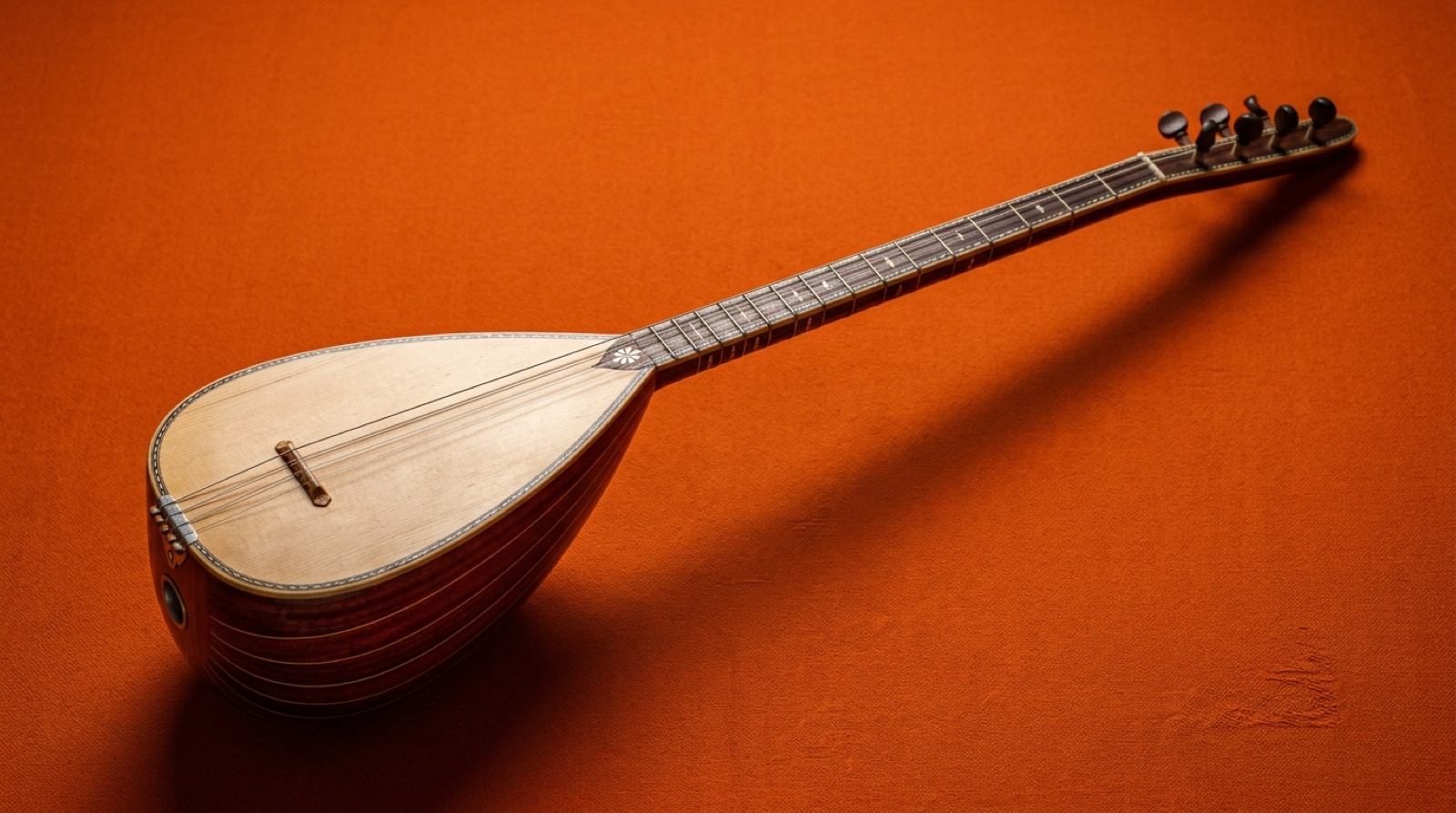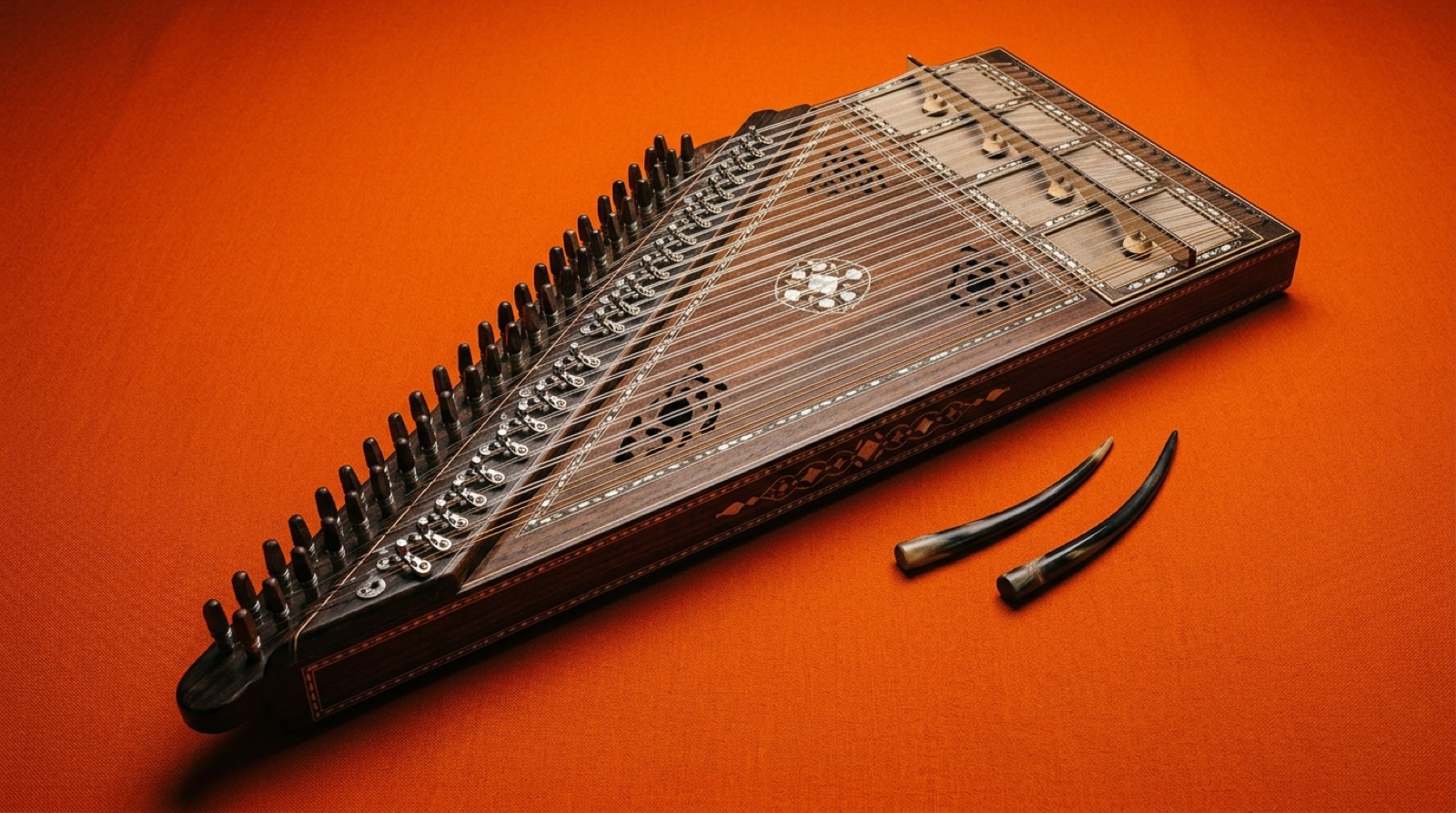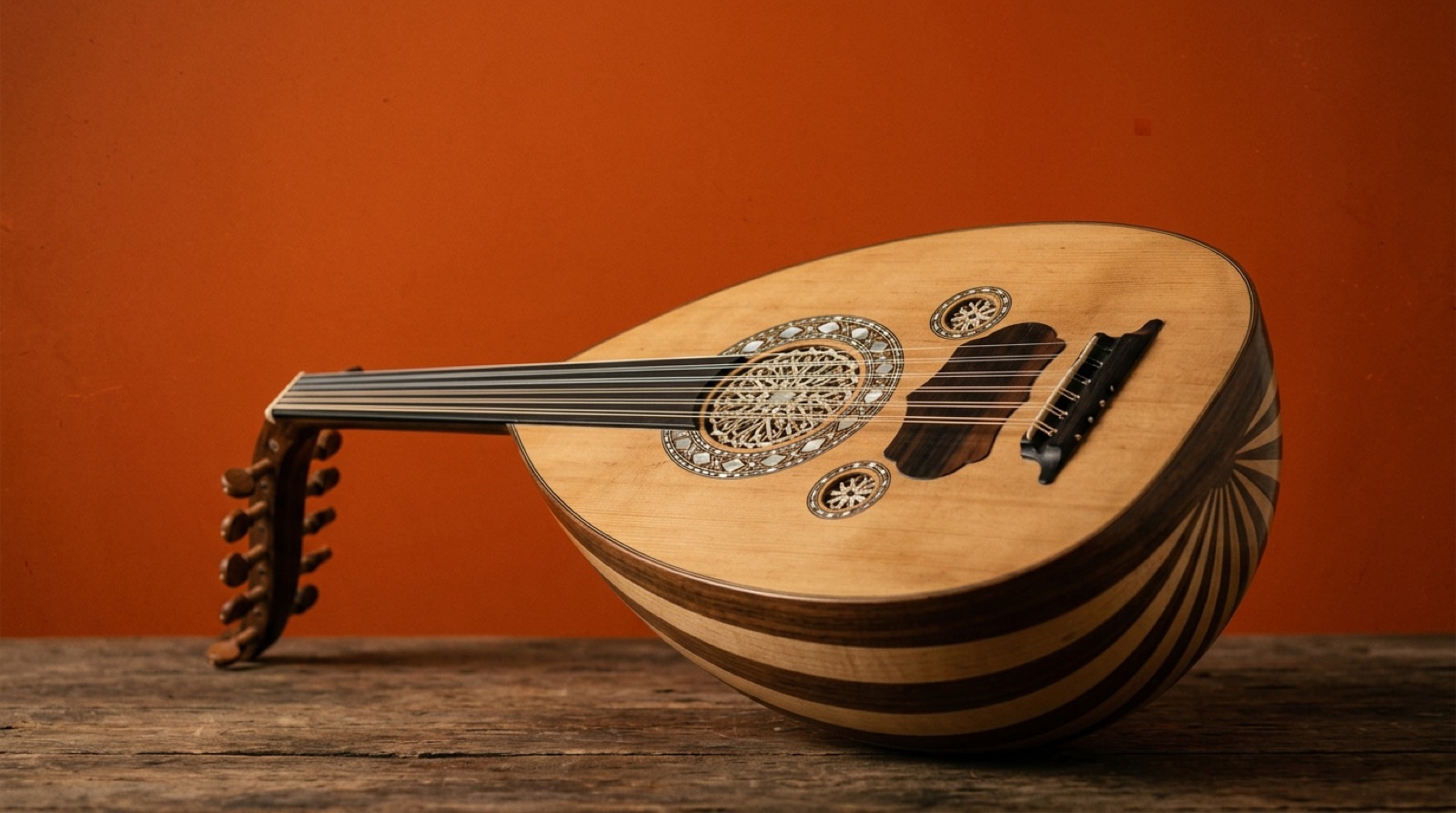
- Strings
- 11 (5 double courses + 1 single bass)
- Neck
- Fretless, ~22 cm playable length
- Body
- Rounded bowl, 19–21 wood ribs
- Family
- Ud / oud (Ottoman classical)
- Default tuning
- Türk Akort — D2 A2 D3 G3 B3 E4 A4
The ud is older than the alphabet most of us learned to read. By the time Farabi was writing the Kitab al-Musiqa al-Kabir in the 10th century, the ud already had its modern shape — a rounded wooden bowl, a short bent peghead, no frets at all. We added a string and changed the tuning. Most of the rest stayed.
What changed in Turkish hands was the geography of the strings. The Arabic ud uses one tuning. The Ottoman ud uses another. Maqam ships three.
Türk Akort — the Ottoman standard
The Turkish ud is tuned, low to high: D2 — A2 — D3 — G3 — B3 — E4 — A4. Notice the bass string sits alone (the only single string on the instrument), and the five double courses climb in intervals that look strange to anyone raised on the guitar: a fourth, a fourth, a fourth, a major third, a fourth, a fourth.
That major third in the middle — between G3 and B3 — is what makes the Turkish tuning Turkish. Arabic uds put a fourth there, which keeps the geometry symmetrical but loses the resonance against the nim hicaz and segâh perdes that the Ottoman repertoire depends on. The Turkish tuning is built around the centre of gravity of Rast.
This is the tuning Cinuçen Tanrıkorur defended in print, the tuning Münir Nurettin Selçuk recorded in, and the tuning Maqam picks up automatically the moment you sound the open G or B strings.
Three tunings, three traditions
Beyond the Ottoman standard, Maqam carries the Şerif Muhiddin Targan tuning — a 20th-century reformist setting that drops the bass D2 down a fourth to A1, giving the instrument a lower centre and a richer resonance for solo virtuoso work. Targan was the first ud player to record a solo concert programme in the European sense; his tuning is still used by his lineage.
The third tuning is the modern Münir Nurettin variant, a slight modification used by ensemble accompanists in the 20th-century radio era. The difference is one semitone on one course — but ensemble blend changes audibly.
Auto-detect handles all three. The signature of the bass course is unmistakeable.
The fretless field
The ud has no frets. This is its defining freedom and its defining demand. Every perde — every microtonal step in the AEU 24-tone system — is found by ear, by finger geometry, by year-after-year practice against a tanbur or a kanun or a tuner.
Maqam was designed to be that tuner. When you press a single string with auto-detect engaged, the gauge moves continuously — not snapping to twelve-tone equal-tempered notes but showing you the cents distance from whatever perde you're aiming at. Nim hicaz sits 23 cents below B-natural; segâh sits 17 cents above F-sharp. The ud teacher who taught you these intervals didn't have a tool that could show them. Now you do.
Every tuning, mapped.
Below is every tuning Maqam ships for the Turkish Ud — straight from the app's reference data. Strings, reference frequencies, related makams, and notes.
Standard Turkish ud tuning. F#2-B2-E3-A3-D4-G4. 'Bacanos' is a practitioner label for the same physical tuning, included as alternative name.
Bam string retuned from F#2 to A2. Used when lower bass register is desired.
Bam string retuned from F#2 to E2 (open E). Provides deeper bass and open-string resonance on E.
Find the perde in your pocket.
The ud will outlive every fashion in instrument design. It already has. Maqam exists in part to make sure the next generation of players can hear the difference between Türk Akort and the variants — and tune accordingly.
 GET
GET