- Strings
- 75 (in 25 courses of 3)
- Body
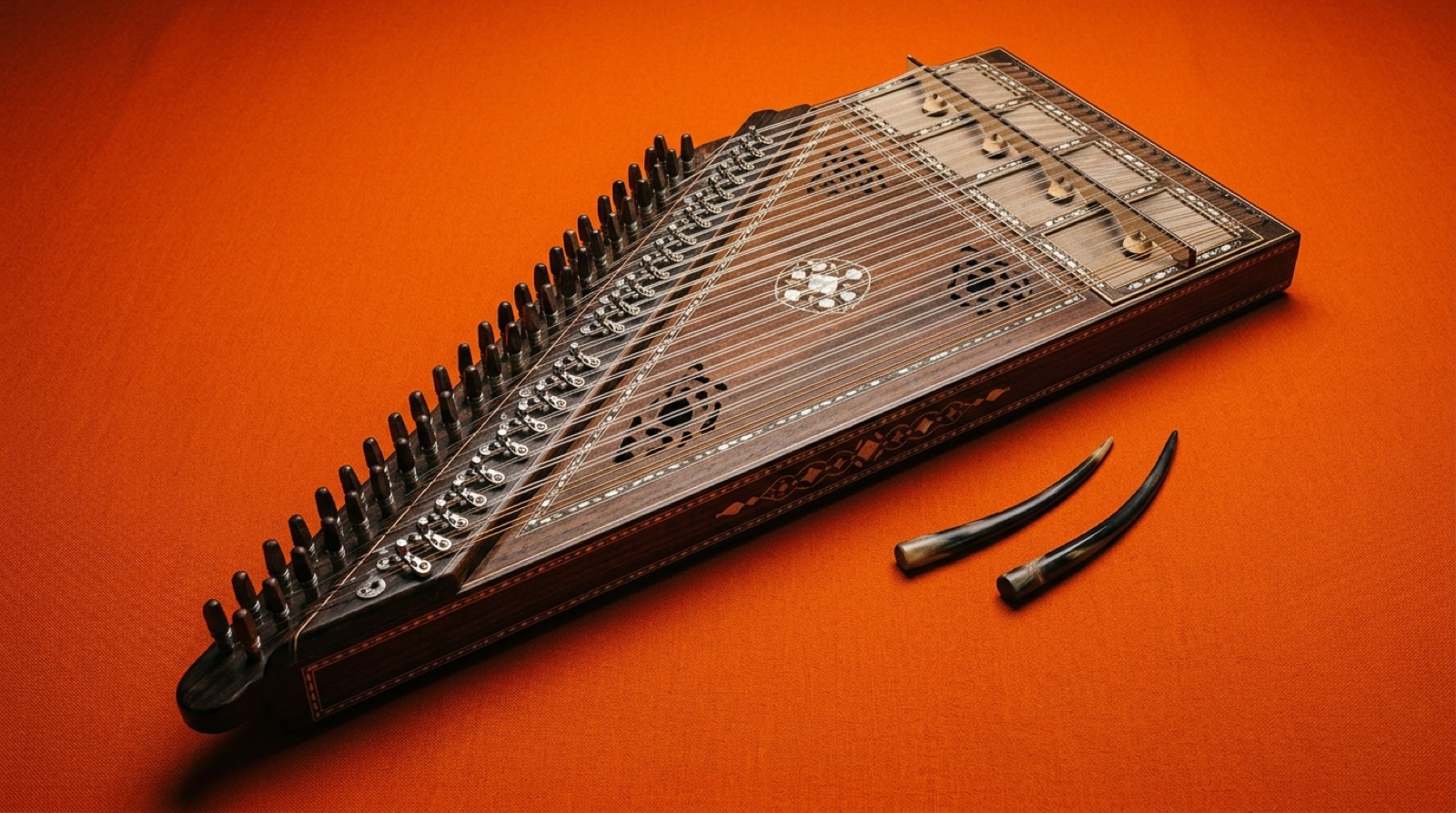
- Trapezoidal, ~95–100 cm long
- Mandals
- Up to 24 silver levers per course
- Family
- Kanun / qanun (Ottoman classical zither)
- Range
- G2 (Kaba Çargâh) — F#4 (Tiz Buselik)
The kanun is the only Eastern instrument with a keyboard. Not literally — there are no keys — but the rows of silver mandals on the left side of the soundboard act as one. Push a mandal up, you raise that perde by a comma. Push it down, you lower it. The entire 53-tone Holdrian comma system is laid out in mechanical detail across about fifteen centimetres of polished metal.
This is also why the kanun is the most demanding instrument to tune. Seventy-five strings, twenty-five courses, and every course has up to twenty-four mandal positions that have to be calibrated.
The 25 courses
The standard Turkish kanun has 25 courses of strings. Each course is three strings tuned to the same pitch in unison, so the total string count is 75. The lowest course is Kaba Çargâh — G2, the bottom of the AEU staff — and the highest is Tiz Buselik, F#4 nearly two octaves up.
Maqam ships the kanun with all 25 perde positions and their reference frequencies. When you switch the kanun on inside the app, the picker shows the full vertical ladder — Kaba Rast, Kaba Dügâh, Yegâh, Hüseyni Aşiran, Acem Aşiran — every named perde of the Ottoman makam system, in the exact place the instrument's first course should sit.
Mandals — a mechanical microtonal keyboard
Each course passes under a row of small silver levers near the bridge. These are the mandals. When you flip a mandal up, a tiny metal blade rises and shortens the vibrating string length by a precise amount — raising the pitch by one comma (1/9 of a whole tone in the Holdrian system).
Twenty-four mandals per course means a kanun player can raise or lower any note by up to 24 commas. In practice, makam playing rarely uses more than 6–8. But the mechanism is there for everything from Nim Hicaz (1 comma flat from B) to Tiz Segâh (3 commas sharp from F).
A well-set-up kanun has all mandals in their "down" (neutral) positions tuned to a specific reference — usually Bolahenk ahenk. Maqam lets you tune to that reference and then flip mandals up as the piece demands. The auto-detect snaps to whatever the comma offset is.
Reading the kanun in Maqam
When you open the kanun in the app, the perde ladder runs vertically — exactly the way the courses sit on the instrument. The active perde is highlighted, the cents gauge shows your distance from that target, and AUTO will jump to whichever course you've plucked.
The kanun teaches you, more than any other Eastern instrument, that makam is not melody. Makam is the relationship between perdes. The kanun makes those relationships physical — you can see the comma between Rast and Dügâh, you can hear the comma between Nim Zirgüle and Zirgüle. Twenty-five courses, seventy-five strings, hundreds of named positions. Maqam gives you the map.
Every tuning, mapped.
Below is every tuning Maqam ships for the Kanun — straight from the app's reference data. Strings, reference frequencies, related makams, and notes.
Kanun: 24 perde groups across ~3 octaves (each group is 3 unison strings). Mandal-based makam presets (Hicaz, Uşşak, Rast, Saba) come in Pro.
Find the perde in your pocket.
The kanun is the closest thing makam has to a written constitution. Every named perde has its place. Maqam treats it that way.
 GET
GET