- Strings
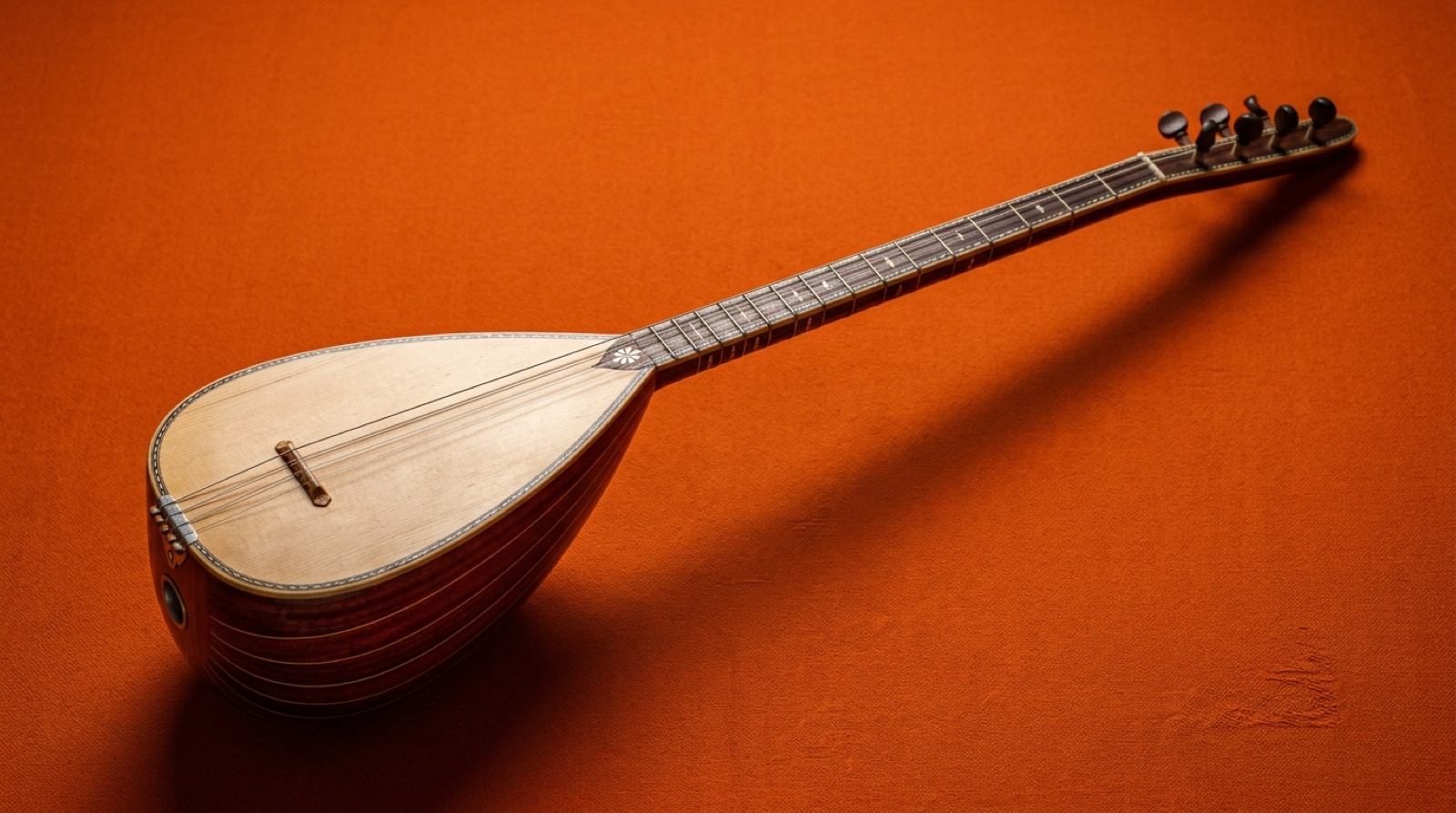
- 7 (in 3 courses — 2 + 2 + 3)
- Neck
- ~55 cm, tied gut frets, ~17–19 perde
- Body
- Teardrop, deep ribbed mulberry bowl
- Family
- Saz / Bağlama (Anatolian folk)
- Default tuning
- Bozuk Düzen (Kara Düzen) — A3 D4 G4
There is no single bağlama. There is the bağlama you bought in Ankara because your father grew up listening to Aşık Veysel, and there is the bağlama your cousin in Adana plays at weddings, and they are the same teardrop body with the same long neck and yet they will never agree on which string sits on top.
The bağlama is not really an instrument. It is a frame for nineteen tunings, and the choice of tuning is the choice of where you are from. We mapped all nineteen.
Bozuk and Bağlama düzen — the two standards
If you walk into a music shop in Istanbul and ask for a bağlama, the strings will be tuned to Bozuk Düzen: A3 on the bass course, D4 on the middle, G4 on the top. Two perfect fourths stacked. It is sometimes also called Kara Düzen, "black tuning," because it is the default — the unmarked case, the tuning you assume when nothing else has been said.
Move two strings up by a tone — change G4 to E4 — and you have Bağlama Düzeni, also called Aşıklama. This is the tuning the great aşıks, the wandering minstrel-poets of Anatolia, used. It is the tuning Aşık Veysel used. The interval becomes a perfect fourth and a major second, A-D-E, and the karar (resolving tone) shifts to Mi. The whole melodic geometry of the instrument changes with that single semitone.
Inside Maqam these are the two tunings the app proposes first. Auto-detect picks them up from the moment you pluck the bass string — D-A-D and D-A-G are the harmonic signatures of the entire long-neck repertoire.
Regional düzens — the rest of the country
Past the two standards, things get specific. Misket Düzeni raises the top string to F#4, producing a tritone over the bass — perfect for Misket itself and for Hicaz-flavoured türküs from the Konya plateau. Müstezat drops to F natural and gives you the dark colour of Hicaz on the bass course. Abdal Düzeni takes the entire instrument down to G-D-G for Alevi cem ritual.
Each of these tunings was developed for one specific song or one specific region — sometimes for one specific türkü that demanded a particular geometry on the fretboard. Tuning a bağlama is a cultural act, not a mechanical one.
Maqam ships all nineteen with their related makams annotated. When you select Misket Düzeni, the app tells you which makams sit naturally under that tuning. When you select Bozuk, it suggests Rast, Nikriz, Hicazkâr, and Nihavent. The pairing is not a recommendation — it is how the tradition is organised.
Transposition and ahenk
The bağlama doesn't sit at a fixed pitch. Folk traditions in Anatolia use ahenk — a system of named transpositions roughly equivalent to a vocalist's "key." A baglamacı in the Aegean might tune everything up a minor third to "Do" (C4 = 262 Hz, the TRT THM reference standard). A teacher in eastern Anatolia might stay at "La" (A3 = 220 Hz, the natural reference).
In Maqam, this is handled by the transposition preset dropdown. Pick your düzen first, then pick your ahenk. The app shifts every reference frequency in lockstep — so Bozuk Düzen at La gives you 220 / 294 / 392 Hz, while Bozuk Düzen at Do shifts everything up a minor third.
This pairing — düzen × ahenk — is the bağlama's two-dimensional tuning matrix. We chose to expose both because hiding one collapses the instrument's identity into a single fixed-pitch object, which it is not.
Every tuning, mapped.
Below is every tuning Maqam ships for the Long-neck Bağlama — straight from the app's reference data. Strings, reference frequencies, related makams, and notes.
Default reference: A=220 Hz natural. Apply transposition preset to shift. Most widely used long-neck tuning. Interval: P4 + P4 (A-D-G).
Karar sesi Mi. Interval: P4 + M2 (A-D-E). Distinguished from Bozuk only in the üst tel (Mi instead of Sol).
Named after the folk song 'Misket' (also: 'Güvercin Uçuverdi'). Karar sesi Fa#. Interval: P4 + tritone (A-D-F#).
Also written 'Fa Müstezat' to distinguish from Do Müstezat (#5). Karar sesi Fa. Interval: P4 + m3 (A-D-F).
Also called 'Rast Düzeni'. Karar sesi Do. Interval: m3 + P5 (A-C-G).
Find the perde in your pocket.
If you only play one bağlama tuning your whole life, you'll be in good company. But if you ever want to step from Bozuk into Misket — or from Aşıklama into the deep Alevi tunings around Abdal — Maqam is the field guide.
 GET
GET