- Strings
- 11 (3 main double courses + sympathetics)
- Body
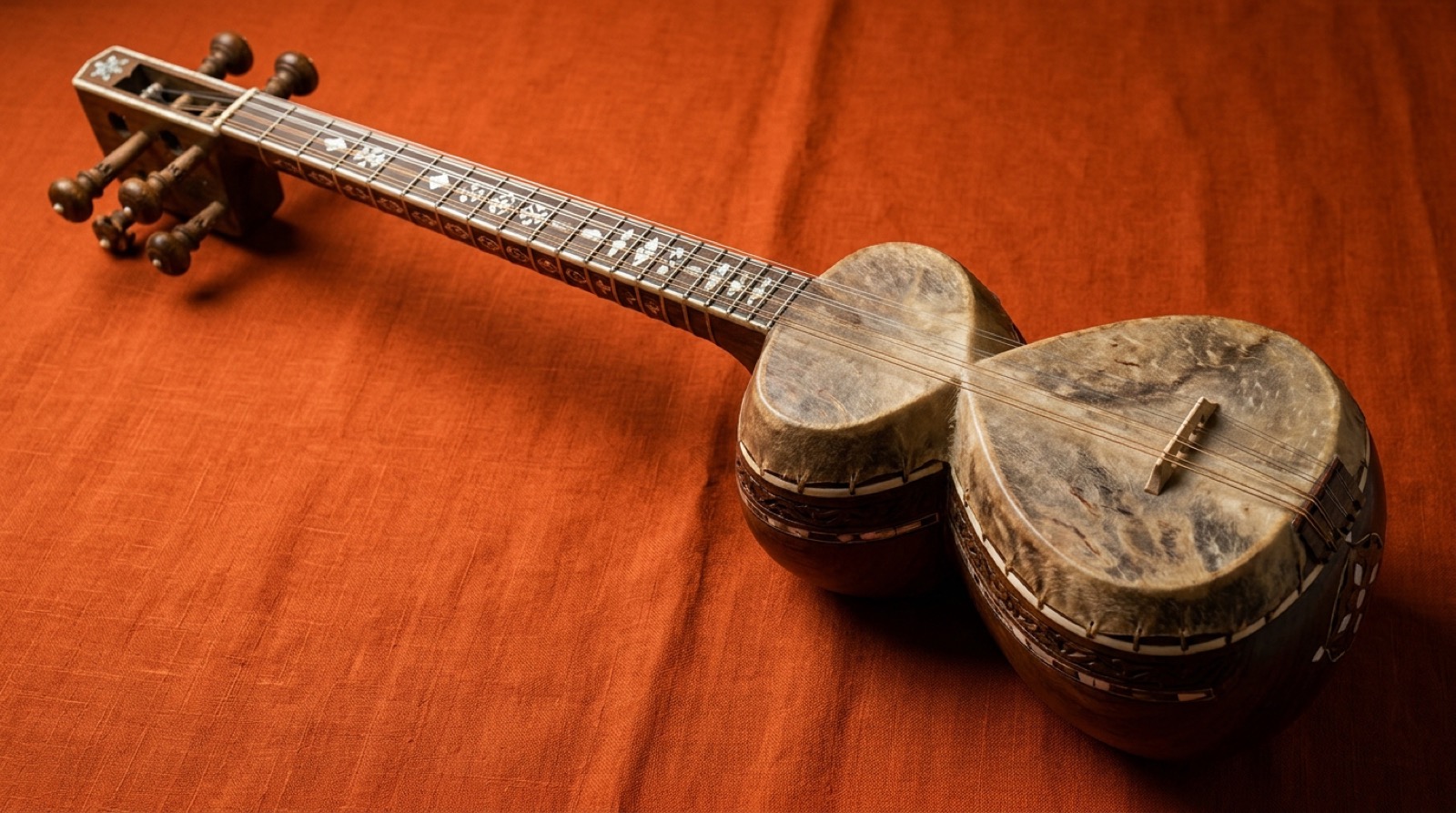
- Double-bowl figure-eight, mulberry wood
- Soundboard
- Stretched ox-heart membrane
- Family
- Tar (Caucasian classical / Azerbaijani)
- Default tuning
- Standard mugham tuning
The Azerbaijani tar is one of the most acoustically peculiar instruments in the Eastern repertoire. The body is a figure-eight double bowl carved from a single block of mulberry — not assembled from ribs like an ud, but hollowed out. Across the smaller of the two bowls is stretched a membrane, traditionally ox-heart pericardium, that vibrates like a drumhead under the strings.
Eleven strings run across the body: three double courses for melody, then five sympathetic strings that ring out underneath without being plucked directly. The result is a sound that no other lute in the world produces — bright, nasal, full of overtones, with a sustained ringing background.
Three courses, eleven strings
The three main melodic courses are tuned in fourths: C4 — G4 — C5 as a baseline (with some regional variation). The top course is doubled (two strings tuned in unison), the middle course is tripled (three strings in unison), and the bass is a single string. That's six right there.
The remaining five strings are sympathetics — not plucked, but tuned to specific perdes of the mugham being played. They ring whenever those perdes are sounded on the melodic strings. This is what gives the tar its distinctive resonant cloud.
Tuning the ox-heart drum
The skin head is the tar's most temperamental feature. As ambient humidity shifts, the membrane tension shifts, and the entire instrument's pitch drifts. A tar that was perfectly tuned at home will be 30–50 cents flat by the time it reaches a concert hall.
Tar players have learned to retune from the membrane outwards — first the bass string against the perceived membrane resonance, then the other courses against the bass. Maqam's tar preset gives you a reference for each of the eleven strings, sympathetics included. Auto-detect can be set to follow whichever string you're working on.
Mugham and the seven modes
Azerbaijani classical music is organised around mugham — a system of seven primary modes (Rast, Şur, Segâh, Şüştar, Çahargâh, Bayatı-Şiraz, Humayun) that overlaps significantly with the Ottoman makam system but uses different perde positions and modulatory paths.
The tar is the central instrument of mugham. Its fretted neck makes the seven modes' microtonal structure physical and visible. When Maqam shows the tar's open-string reference frequencies, the player can derive the rest of the mugham scale by reading along the neck.
Every tuning, mapped.
Below is every tuning Maqam ships for the Azerbaijani Tar — straight from the app's reference data. Strings, reference frequencies, related makams, and notes.
Azerbaijani tar: 6 melody (course1 octave C3+C4, course2 unison G3+G3, course3 unison C4+C4) + 1 bass G2 drone + 4 sympathetic 'zeng' strings (G4×2, C5×2). Reference: Wikipedia, Instruments Wiki, Organology.net.
Find the perde in your pocket.
The tar is mugham's most articulate voice. Maqam treats it with the same precision the tradition demands.
 GET
GET