- Strings
- 7–8 metal
- Neck
- ~110 cm, tied gut frets at every comma
- Body
- Small hemispherical wooden bowl
- Family
- Tanbur (Ottoman classical)
- Default tuning
- Standard Bolahenk — A2 D3 A3
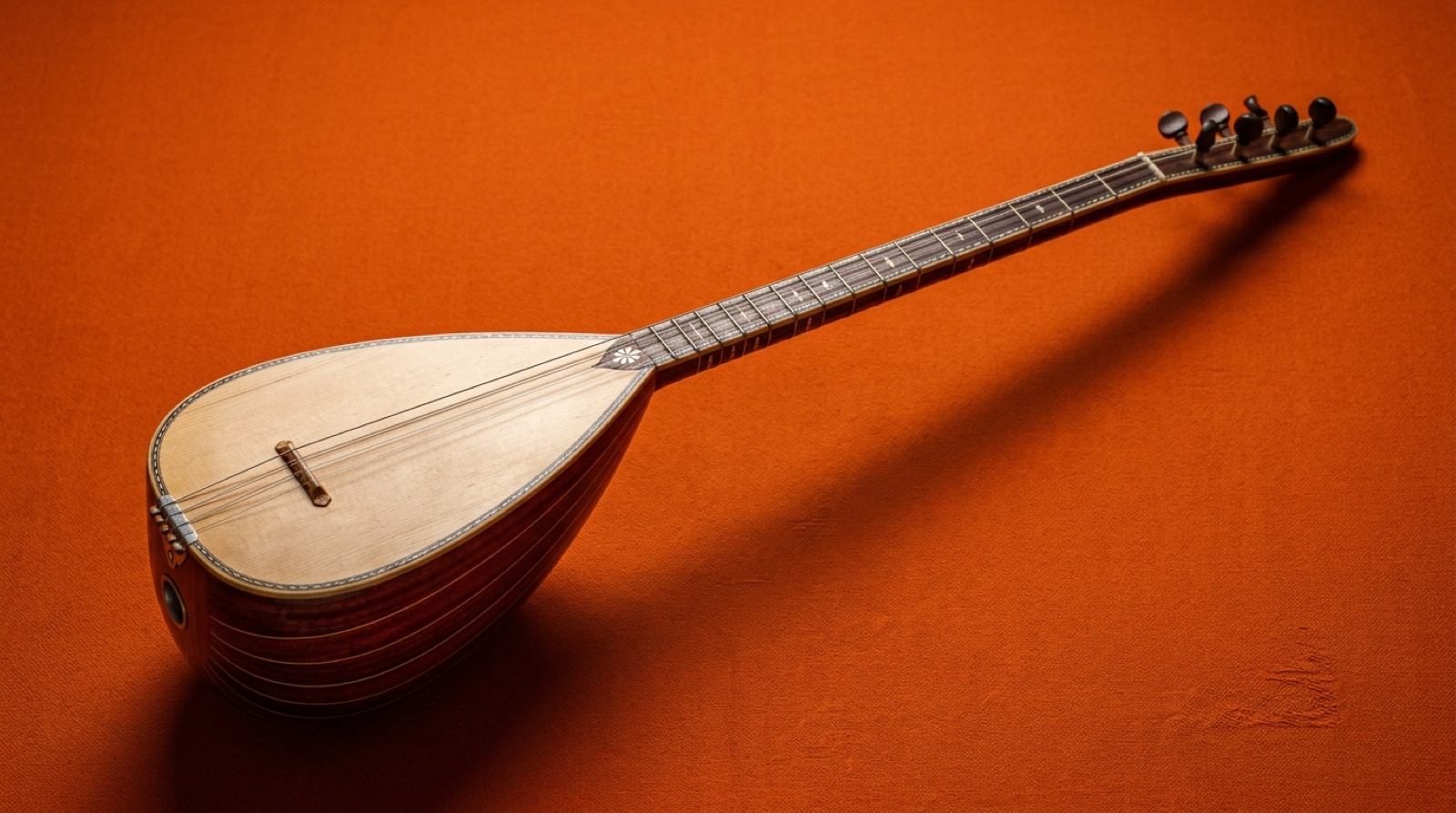
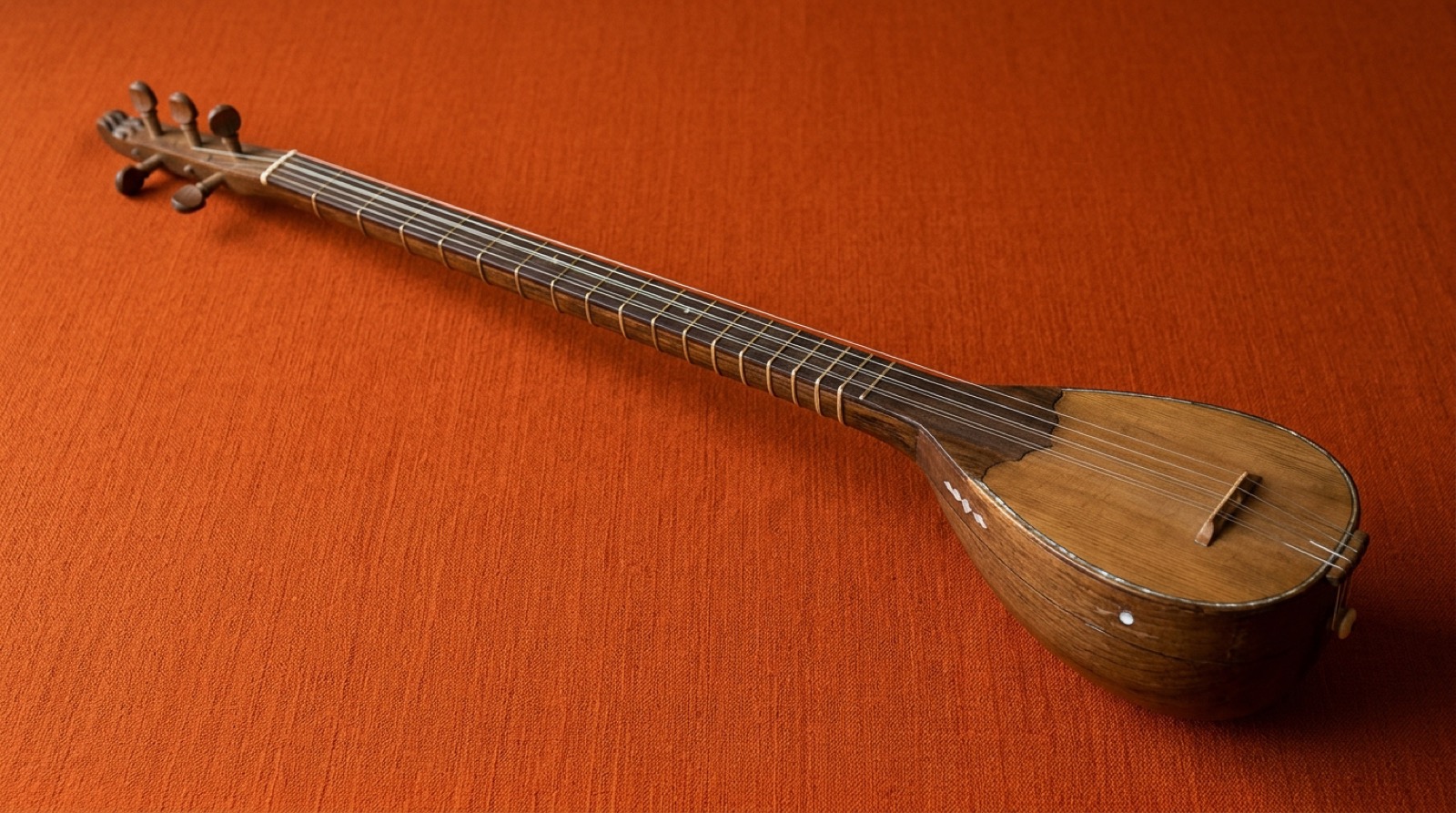
If the kanun is the kingdom of the comma, the tanbur is its arithmetic. The instrument is more than a metre long, almost entirely neck, with tied gut frets at every comma position of the 53-tone Holdrian system. There are no frets like this anywhere else in the world.
The tanbur exists to prove the makam intervals are real. You can see them.
Seven strings, one melody
The standard mızraplı tanbur has 7 metal strings, but only the top string carries the melody. The other six are drones — they ring open or are damped, providing the harmonic frame against which the melody string moves. Some players run 8 strings, splitting the top course in two.
The drone strings are tuned to the karar (resolving tone) of the piece — usually La (A) for Bolahenk ahenk, the default Ottoman setting. The melody string starts on A3 and moves up the long neck, hitting each comma fret as it climbs through the makam.
The 53-tone fretboard
From the open A3 string upward, the tanbur's neck is divided into 53 commas per octave. Not 12 semitones. Fifty-three. Every fret is tied gut, every position is named, every comma is audible.
This is where AEU notation lives. Nim Hicaz is 4 commas above the open string. Hicaz is 5. Segâh is 13. The neck is so long because each fret has to be perceptually distinct from its neighbour — at standard string tension, that distance is about 1.5 to 2 centimetres per comma at the upper end. Without that length, the player can't reliably place a finger on the right perde.
Maqam's tanbur view shows you exactly where you are in this lattice. The cents gauge becomes the equivalent of the gut fret under your finger — when you're inside ±10 cents of a comma, you're "on the perde."
Why the tanbur is in Maqam at all
Most tanbur players have spent decades tuning by ear against another player or a piano. A tuner is not how the tradition learns this instrument. But there is one moment when a tuner saves you: setting the open drones.
If the open strings aren't perfectly in tune with each other and with the melody string's open A, the entire harmonic frame collapses. Drones must be exact octaves and fifths or the comma intervals on the melody string read as noise instead of meaning.
Maqam's tanbur preset is precisely this: a tuning reference for the open courses, accurate to a cent, in any ahenk you choose. Once the open strings are right, the player does the rest.
Every tuning, mapped.
Below is every tuning Maqam ships for the Mızraplı Tanbur — straight from the app's reference data. Strings, reference frequencies, related makams, and notes.
8 strings: 1 thick brass drone (Kaba Yegâh A1=55) + Yegâh A2=110 main course + Kaba Rast G2=98 as the 'one whole tone below Yegâh' resonance string. Verified via Cinucen Tanrıkorur method (semazen.net, mutriban.com).
Find the perde in your pocket.
The tanbur exists because the makam tradition needed a physical proof that the comma is real. After 400 years it is still the proof.
 GET
GET