- Strings
- 3 (some variants 4)
- Body
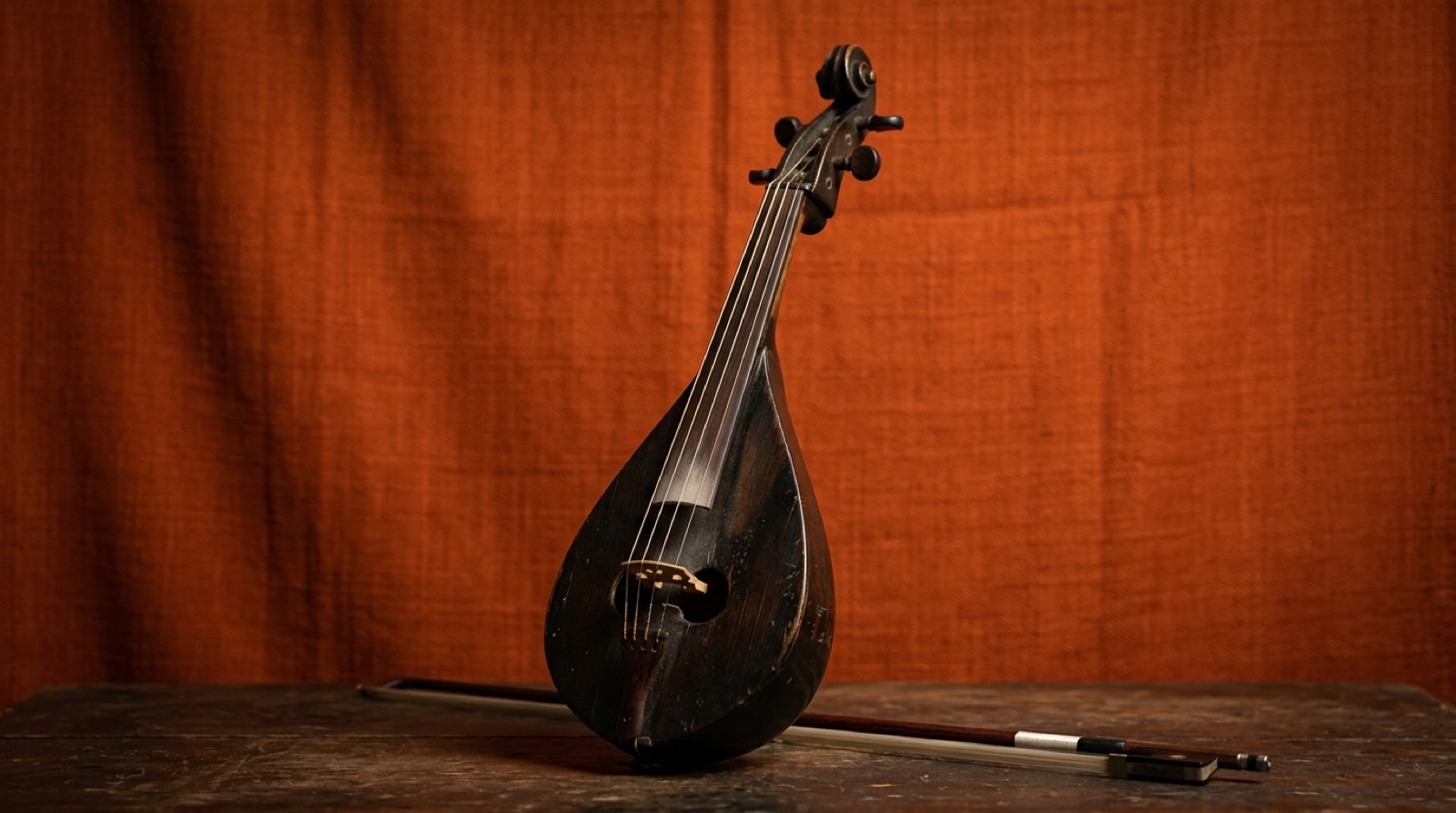
- Pear-shaped (armudi), ~40–41 cm long
- Bow
- Horsehair, played upright on knee
- Family
- Klasik kemençe (Istanbul / armudi)
- Default tuning
- D4 A3 D3 — fifths and fourths
There are three Turkish bow-fiddles called kemençe and only one is the classical one. The classical kemençe — klasik kemençe, sometimes armudi kemençe for its pear shape, sometimes İstanbul kemençesi for where it was perfected — is played sitting down, the body resting upright on the player's left thigh, the bow held underhand like a viol.
It has three strings. It is the size of a small forearm. It can sing.
The fingernail technique
The klasik kemençe is fretless. But the player doesn't press strings against a fingerboard — there is no fingerboard. Instead the fingernail touches the string from the side, like a finger against a violin string in harmonic position. The player's nail is the only stopping mechanism.
This is the technique that gives the kemençe its voice. Vibrato emerges naturally from the lateral nail pressure. Glissandi between perdes are not ornaments — they are how the instrument moves. The Istanbul taksim style for klasik kemençe is built around this physical fact.
Three strings in fourths and fifths
The standard tuning, low to high, is D3 — A3 — D4. A perfect fifth followed by a perfect fourth — exactly the inverse of a violin's lower strings. The top D4 carries most of the melody. The lower strings act as drones, sympathetic resonators, and occasionally as melodic strings when the player drops a position.
This is the tuning Maqam loads automatically. Auto-detect tracks the top D4 string with high sensitivity because that is where 95% of the played pitch lives.
Why the kemençe is so hard to tune
Gut strings on a tiny body with no fingerboard means the kemençe is extraordinarily temperature- and humidity-sensitive. A player who tunes before a concert and then waits in a warm dressing room for thirty minutes will find their D4 has drifted up by 20–30 cents.
Maqam's high-resolution cents readout is built for exactly this scenario — you can re-tune in 5 seconds, in the dark, between pieces, with the bow still in your right hand. The needle gauge is calibrated so that within ±10 cents counts as "in tune" for the kemençe player. Closer than that is impossible at this string tension.
Every tuning, mapped.
Below is every tuning Maqam ships for the Klasik Kemençe — straight from the app's reference data. Strings, reference frequencies, related makams, and notes.
Find the perde in your pocket.
The klasik kemençe sounds like a singer. It is the closest the instrumental repertoire of makam music gets to the human voice. Tune it carefully, and it will sing back.
 GET
GET