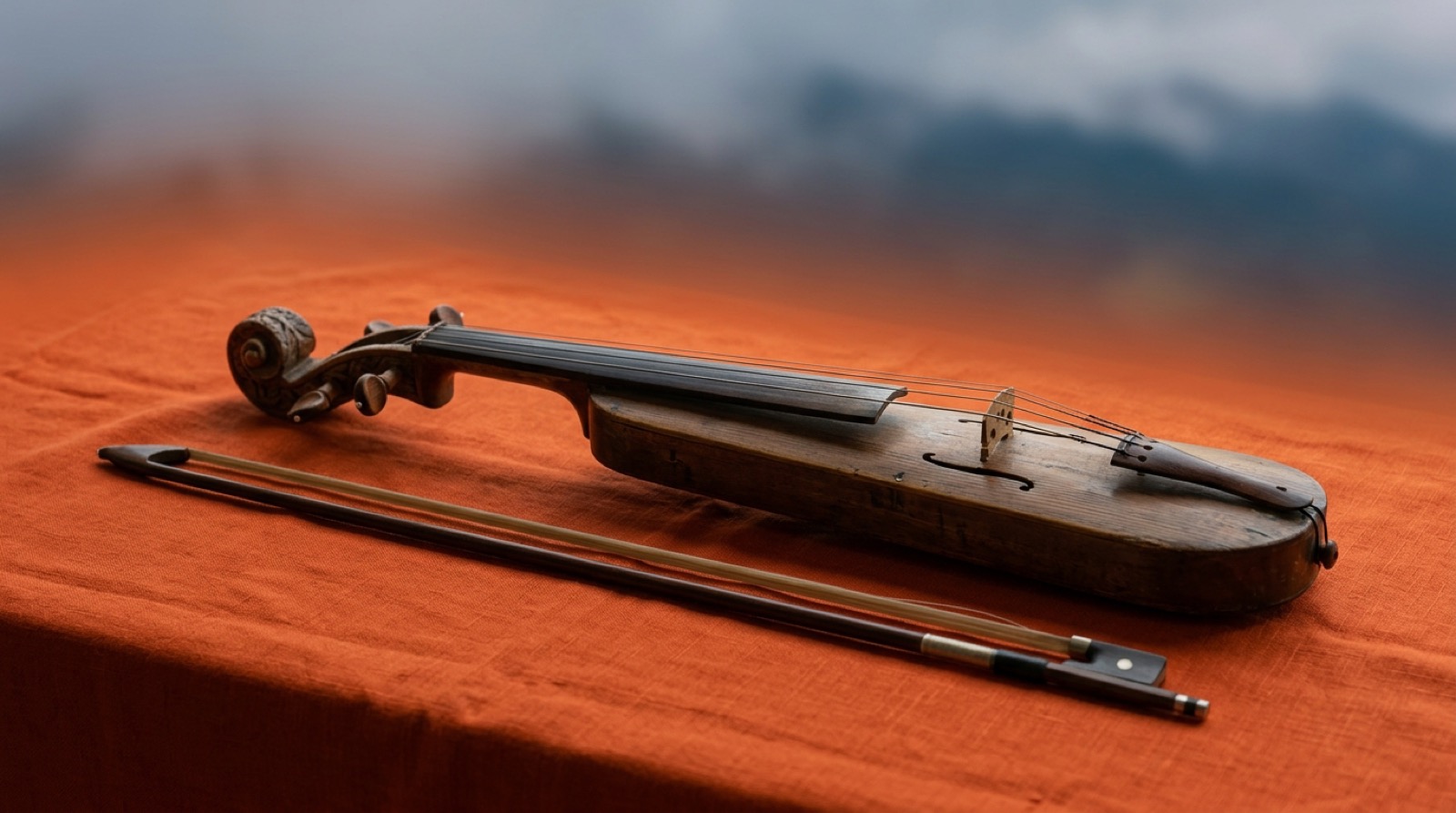
- Strings
- 3 (steel or gut)
- Body
- Narrow, elongated, ~55 cm × 14 cm
- Bow
- Short, held overhand
- Family
- Karadeniz kemençesi (Pontic / Black Sea folk)
- Tunings
- Sol-Re-La · Yöresel · La-Re-Sol
The Karadeniz kemençesi is not a smaller cousin of the klasik kemençe. It is a completely different instrument that happens to share a name. Long and narrow where the classical kemençe is round, played with a short bow held overhand instead of underhand, three strings tuned not in mixed fourths and fifths but in parallel fifths — the Black Sea kemençe has its own genealogy.
It is also the instrument behind every horon, every wedding, every 7/8 meter east of Trabzon.
Parallel fifths — the drone trick
The standard Karadeniz tuning is Sol — Re — La, low to high. Two perfect fifths stacked. This is unusual: most three-string bowed instruments tune in fourths or in mixed intervals.
The reason is technique. Karadeniz players almost always bow two strings at once, producing a parallel-fifth drone under every melody note. The melody moves on the top string while the middle string rings a constant fifth below. This is what gives Black Sea kemençe music its distinctive nasal, droning, march-like quality.
Tune the strings in fifths, and parallel-fifths happen automatically every time you draw the bow across both strings. Tune them any other way, and the technique falls apart.
Three tunings, three districts
Maqam ships three Karadeniz kemençe tunings. The standard Sol-Re-La is the Trabzon-area tuning, used in most recorded Pontic music. The Yöresel variant lowers the top string by a tone for specific local horons. The La-Re-Sol tuning inverts the geometry — used in eastern districts toward Rize and Hopa for a darker drone.
These tunings are not regional curiosities. They are functional choices — each one places a different set of pitches under the bow and changes which horons can be played without re-fingering.
Tuning a wet instrument
The Black Sea coast is wet. Karadeniz kemençes spend their lives in 80% humidity. Their pegs slip. Their strings shift. A player who arrives at a wedding from a cold drive needs to tune in two minutes, between sips of çay, with the band already starting.
Maqam's auto-detect is calibrated for this scenario. The high-contrast neon green readout means you can tune in bright sun on a coastal terrace. The detection sensitivity is set to pick up steel strings even when the rest of the band is playing in the next room.
Every tuning, mapped.
Below is every tuning Maqam ships for the Karadeniz Kemençesi — straight from the app's reference data. Strings, reference frequencies, related makams, and notes.
Trabzon-Maçka tulum style, double-La drone.
Find the perde in your pocket.
Three strings, three tunings, infinite horons. The Karadeniz kemençesi is folk music distilled into the smallest bowed instrument in Anatolia.
 GET
GET