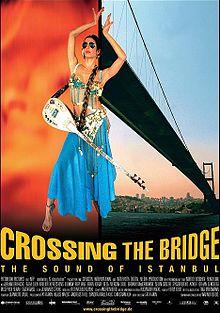
- Film
- Crossing the Bridge: The Sound of Istanbul (2005)
- Director
- Fatih Akın
- Host
- Alexander Hacke (Einstürzende Neubauten)
- Festivals
- Cannes (out of competition) · Sundance · Toronto · Berlinale (special screening)
- Featured
- Orhan Gencebay, Sezen Aksu, Mercan Dede, Brenna MacCrimmon, Selim Sesler, Müzeyyen Senar, Ceza, Erkin Koray
In 2004 Fatih Akın won the Golden Bear at the Berlinale for Head-On, a love story that ricocheted between Hamburg and Istanbul. He used the prize money to do something nobody had asked for: make a documentary about Istanbul's music. He handed a Sennheiser microphone to Alexander Hacke — the bass player of Einstürzende Neubauten, the German industrial-art band — and told him to wander.
The result, Crossing the Bridge: The Sound of Istanbul, came out in 2005 and is now the single most-watched non-Turkish-language introduction to Turkish music. It screened at Cannes, won the European Film Award for Best Documentary, and has been a fixture of European world-music festivals ever since.
The film's architecture
What Akın and Hacke did was not a survey. There is no neat genealogy, no Ken Burns timeline. Instead, the film moves through Istanbul as if through layers of geological sediment. The top layer is Turkish hip-hop (Ceza); below it psychedelic rock from the 1970s (Erkin Koray); below that the urban folk of arabesk (Orhan Gencebay's bağlama); below that the Romani clarinet of the Edirne wedding circuit (Selim Sesler); below that the imperial classical tradition (Müzeyyen Senar, recorded in her apartment, age 87); below all of it the Sufi ney and the electronic re-Sufism of Mercan Dede.
Every stratum overlaps. Mercan Dede plays a saz line over a 4/4 club beat. Sezen Aksu — the pop singer who shaped a generation — confesses that the songs on her last album were Romani-folk arrangements. The bağlama appears in every layer.
Orhan Gencebay's bağlama
The film's longest sequence belongs to Orhan Gencebay, the founder of arabesk — the genre that connected the bağlama to the arrival of millions of rural migrants in Istanbul in the 1960s and 70s. Gencebay sits in his studio and plays a single Hicaz taksim. He uses a short-neck bağlama tuned in Kara Düzen — the tuning Maqam ships as default for the short-neck. Watch the film and you can hear the open-string drone underneath the melody. That drone is the harmonic identity of arabesk; remove it and the entire genre dissolves.
Selim Sesler and the Edirne clarinet
The Romani klarnet traditions of Edirne and the Thracian border had been largely invisible to non-Turkish audiences before this film. Selim Sesler — who would later collaborate with the American singer Brenna MacCrimmon on the celebrated Karşılama album — plays a 9/8 karşılama dance in a wedding restaurant, surrounded by accordion, davul drum, and a single bağlama keeping the rhythmic spine. After the film's release Sesler's calendar filled with European tours. He died in 2014; that bağlama line is one of the most-replayed moments in his recorded life.
Mercan Dede and the electronic ney
Mercan Dede (Arkın Allen) was born in Bursa, lived in Montreal, and built a global audience by recording Sufi ney over downtempo electronic beats. The Crossing the Bridge sequence with him is shot on the Bosphorus at night, beats playing through a portable speaker, ney drifting over them. It is now the soundtrack image most Europeans have of contemporary Istanbul.
What Maqam carries from this film
Maqam ships the tunings of every fretted instrument shown in Crossing the Bridge:
- Short-neck bağlama — Kara Düzen (the Gencebay tuning), Misket, Bozuk Düzen, and four other folk düzens
- Long-neck bağlama (cura, divan) — 19 düzens including the high-pitched Karadeniz folk variants
- Turkish ud — Klasik Akort, the tuning used by Münir Nurettin Selçuk and the radio-era ensembles
- Cümbüş — the steel-string banjo-ud hybrid Erkin Koray brought into Turkish rock
Auto-detect handles all of them. The signature of the open courses against the saz body is identifiable in under a second.
The bridge in the title
The bridge is the Bosphorus Bridge — the literal piece of road that connects Europe and Asia. But the film is also about the bridge between tradition and electronic production, between Turkish-language pop and global club culture, between rural folk and urban exile. Twenty years after release, Akın's claim that Istanbul is "the most musical city on earth" has become harder to dispute. Crossing the Bridge is why most of Europe believes it.
 GET
GET