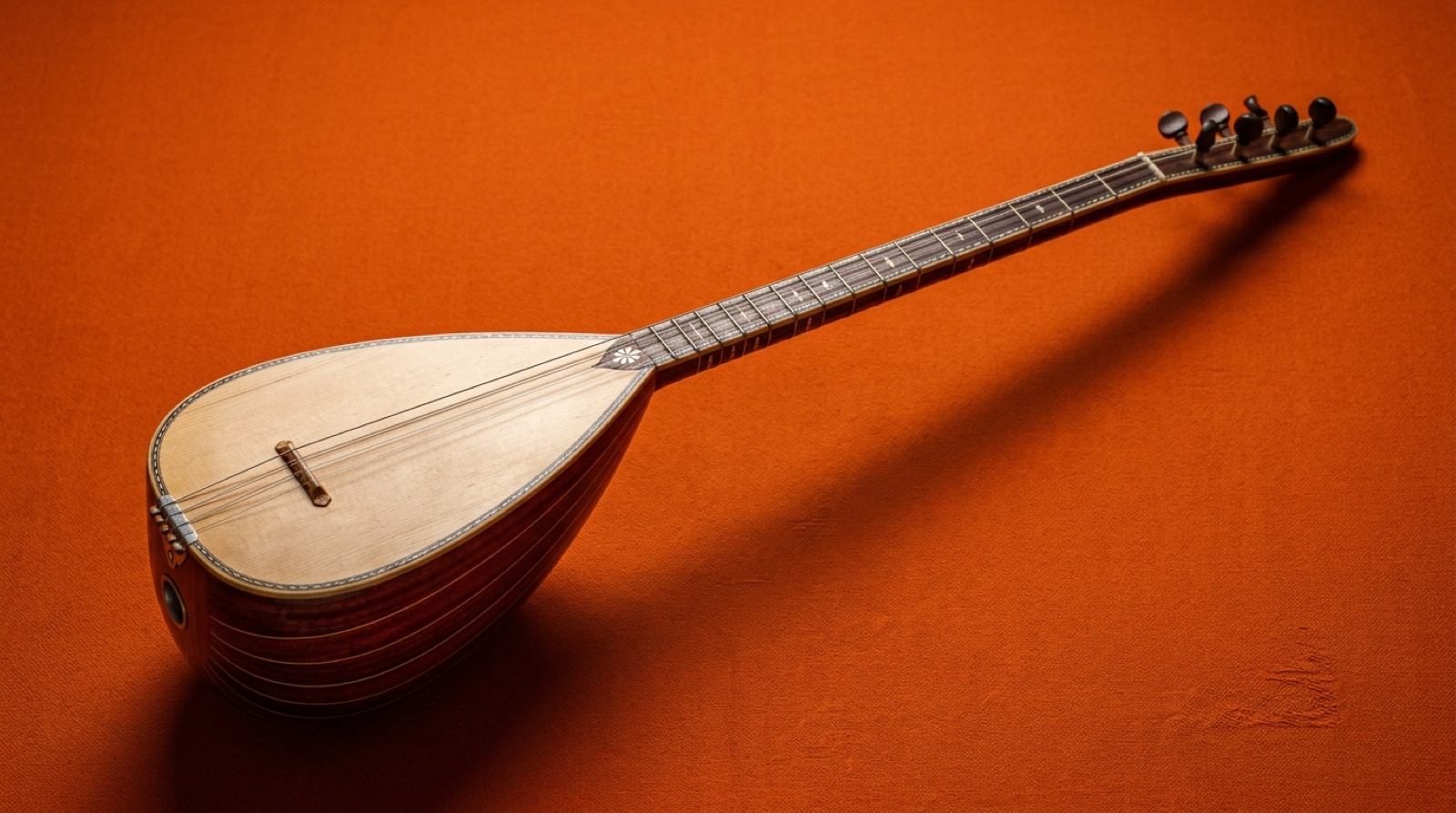
- Strings
- 6 (3 double courses) or with sympathetics
- Neck
- Long, fretted (often moveable frets)
- Body
- Small pear-shaped wooden bowl
- Family
- Buzuq (Lebanese / Syrian)
- Default tuning
- C-G-C — Matar Muhammad style
The Levantine buzuq sits at the intersection of three lineages — the Ottoman ud, the Greek bouzouki (which it shares a name with), and the broader Mediterranean long-necked lute family. The strings are steel, the neck is long, the body is small, and the frets are often moveable so the player can shift between Arabic maqam and Turkish makam intonations without retuning.
Matar Muhammad — the Beirut-based player who turned the buzuq into a concert solo instrument in the 1950s and 60s — settled on a tuning that became the modern standard.
Matar Muhammad's tuning
The classical buzuq tuning before Matar Muhammad varied wildly by region — some players used D-A-D, others G-D-G, others fourths and fifths in arbitrary combinations. Matar Muhammad's contribution was to settle on a tuning that gave the instrument two perfect fifths with the same root: C — G — C.
The geometry made the buzuq a chord-and-melody instrument in a way it hadn't been before. The bass C drones, the middle G sits a fifth above as a stable resonator, and the top C is the melody course at octave. From this base, virtually any maqam can be played by re-fingering rather than re-tuning.
Two tunings in Maqam
Maqam ships the buzuq with Matar Muhammad's C-G-C and a regional variant used in northern Syria. The variant lowers the bottom course by a tone for specific traditional pieces where the bass drone needs to sit on a different maqam tonic.
The frets on most buzuqs are moveable — held in place by string tension and a glue/wax mixture rather than tied down like an ud or lavta. This means the player can micro-adjust comma positions physically, by sliding a fret a millimetre. Maqam helps with the calibration: tune the open string accurately, then sound a stopped note at the fret in question, and the cents readout tells you whether the fret is where it should be.
Why the buzuq travels
Of all the Levantine instruments, the buzuq is the one most likely to be carried across borders. Its small body fits in a soft case, its steel strings handle climate change, and its single-melody-line role means it can join any ensemble in any country. Lebanese players in Sweden, Syrian players in Berlin, Palestinian players in São Paulo — the buzuq goes where the diaspora goes.
Maqam was built for instruments that travel. Auto-detect doesn't care which café you're sitting in. Offline operation means you can tune in airports, on stage, in rural villages, anywhere. The buzuq's tuning shouldn't be the thing that breaks.
Every tuning, mapped.
Below is every tuning Maqam ships for the Buzuq — straight from the app's reference data. Strings, reference frequencies, related makams, and notes.
Modern Lebanese/Syrian buzuq, 3-course.
Traditional / Matar Muhammad-style tuning. One whole step below modern D-A-D.
Find the perde in your pocket.
The buzuq is the most portable expression of the Levantine sound. Maqam keeps it in tune wherever it goes.
 GET
GET